
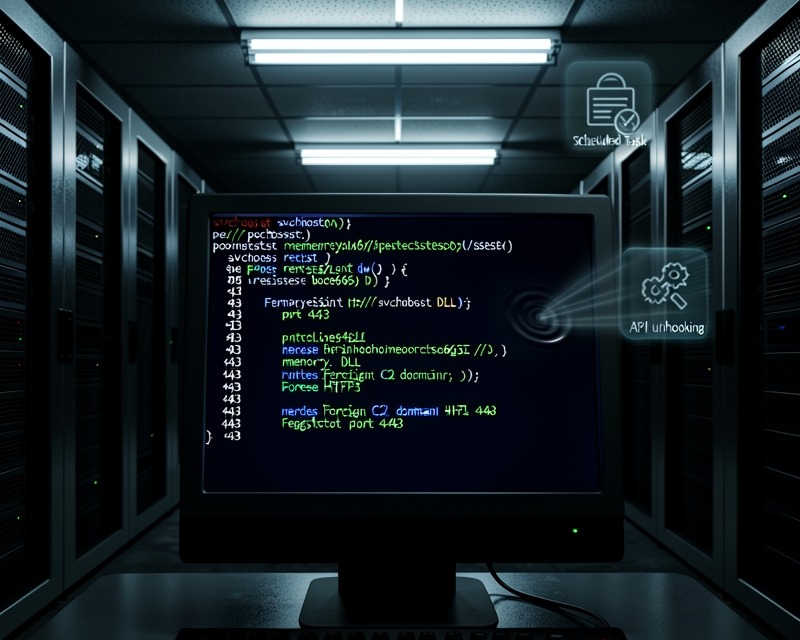
Recent analysis from FOX IT has unveiled a sophisticated new variant of the long‑established Lazarus Group’s RemotePE RAT. Unlike traditional payloads that drop binaries to disk, RemotePE remains entirely in RAM, evading file‑based scanners and making forensic recovery exceptionally difficult. The report, dated 26 May 2026, details how the threat actor leverages memory‑resident execution to maintain persistence, exfiltrate data, and pivot laterally across victim networks. Understanding this new delivery vector is essential for modern defenders.
Tactics, techniques, and procedures (TTPs) exhibited by RemotePE align closely with the Lazarus Group’s known repertoire. The RAT initiates via a spear‑phishing attachment that contains a single PowerShell payload. Once executed, the script downloads a compressed payload, decompresses it in memory, and injects the main RAT binary into a legitimate system process using reflective DLL injection. This approach bypasses the Windows Defender sandbox and keeps the malicious code hidden from disk‑based integrity checks.
Architecturally, RemotePE is a two‑stage engine. Stage 1 is a lightweight loader that validates the target environment, checks for debugging artifacts, and establishes an encrypted channel to the command‑and‑control (C2) server. Stage 2, the full RAT, is a modular DLL that exposes capabilities such as keylogging, credential dumping, and lateral movement via SMB. The loader also implements a stealth mechanism: it unhooks the Windows API functions it uses, so that memory scans do not detect the injection points.
The attack lifecycle begins with initial compromise, typically via a phishing email or a malicious drive. After execution, RemotePE sets up persistence by writing a scheduled task that triggers the loader at system boot, but the task itself is stored in the registry’s RunOnce key, making it invisible to standard process lists. Once active, the RAT communicates over HTTPS with command‑and‑control, sending encrypted payloads. The adversary then enumerates the network, maps privilege levels, and escalates privileges using stolen credentials or local exploits.
Indicators of compromise (IOCs) identified in the report include a custom domain cluster (e.g., example‑c2.com) serving the encrypted loader, a specific SHA‑256 hash for the loader binary, and a unique base64‑encoded string found within the PowerShell script. Network traffic to the C2 domain over port 443 with irregular TLS handshake patterns is another strong sign. Additionally, the presence of a hidden scheduled task or registry RunOnce entry that points to a non‑standard location (C:\Windows\Temp\r.exe) should raise suspicion.
Detecting RemotePE requires a shift from file‑based detection to behavior‑based monitoring. Security analysts should enable memory forensics tools such as Volatility or Rekall to scan for unfamiliar DLLs loaded into legitimate processes like svchost.exe or rundll32.exe. Endpoint detection and response (EDR) solutions must be tuned to alert on reflective DLL injection, API unhooking, and encrypted C2 traffic over standard ports. Integrating threat‑intel feeds that flag the known C2 domains can provide early warning.
Mitigation steps are layered. First, enforce a strict application whitelisting policy that blocks unknown executables from launching. Second, deploy micro‑segmentation to limit lateral movement; network segmentation reduces the blast radius of credential theft. Third, apply the latest security patches to kernel and SMB components to close known exploitation vectors. Finally, implement continuous monitoring for scheduled tasks and registry modifications that deviate from baseline behavior.
For security analysts, the following actions are recommended:
- Validate all suspicious PowerShell scripts via sandbox analysis before deployment.
- Use endpoint telemetry to correlate process injection events with anomalous network activity.
- Maintain an up‑to‑date kill chain map that includes memory‑resident threats.
- Collaborate with SOC teams to share indicators and refine detection rules.
The impact of RemotePE on an organization can be severe. Because the RAT resides only in memory, traditional antivirus solutions may miss it entirely, allowing attackers to exfiltrate large volumes of data without triggering alerts. The ability to pivot laterally means that once a single workstation is compromised, the entire network can be traversed, potentially leading to ransomware deployment or espionage. Early detection is therefore critical to prevent data loss or system compromise.
In conclusion, RemotePE represents a significant evolution in the Lazarus Group’s toolset, emphasizing stealth, persistence, and memory‑resident execution. By combining advanced injection techniques with encrypted C2 channels, the RAT challenges conventional endpoint security. Organizations must adapt by enhancing memory‑forensic capabilities, tightening application controls, and staying current with threat‑intel updates. Proactive detection and rapid response remain the most effective defenses against this sophisticated adversary.
