
Executive Summary
The latest threat intelligence release identifies an advanced adversary group executing a multi‑stage malware campaign known as Operation TaxShadow. Leveraging tax‑themed social engineering, the attackers infiltrate Indian and Japanese organizations through seemingly official correspondence from government authorities. The operation demonstrates a high level of sophistication in both delivery and execution, employing in‑memory loading, DLL hijacking, API hooking, token abuse, cryptographic obfuscation, and WebSocket‑based command‑and‑control to reduce forensic footprints and blend malicious traffic with legitimate network activity.
Campaign Narrative
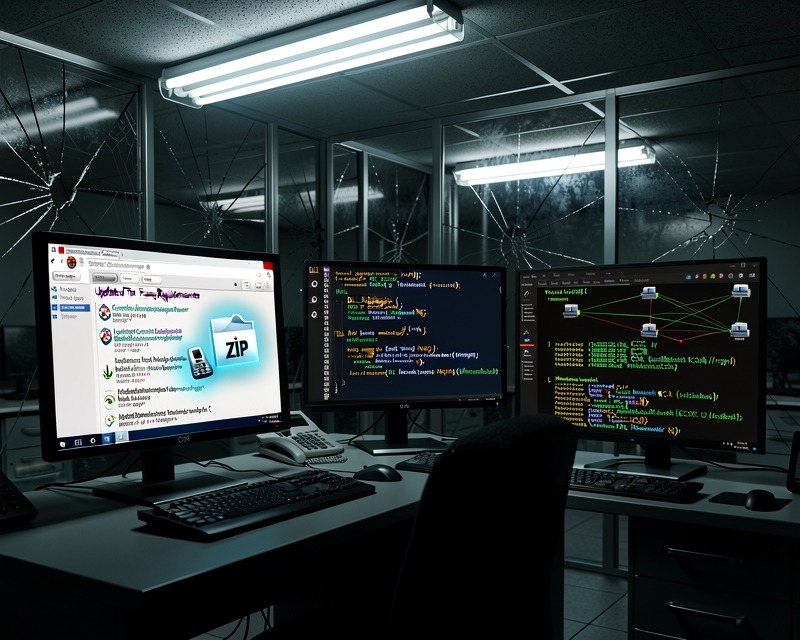
Victims receive a phishing email that mimics an official tax notice. The subject line references “Updated Tax Filing Requirements” while the sender’s address appears to belong to the Indian Revenue Service or Japan’s National Tax Agency. Embedded in the message is a ZIP file, which opens to reveal three distinct payloads: a lightweight credential skimmer, a reconnaissance module that enumerates system information and network connections, and an in‑memory loader that brings the full malware into RAM.
The first stage collects credentials via a keylogger integrated within the ZIP, forwarding them to the adversary’s infrastructure. The second stage gathers detailed host data – installed software, running services, user accounts, and open ports – building a comprehensive asset map for the attackers. Finally, the loader executes the main component without writing any files to disk. This in‑memory execution eliminates traditional file‑based indicators of compromise.
Advanced Evasion Techniques
- DLL Search Order Hijacking: The loader forces the operating system to load malicious DLLs before legitimate ones, allowing the malware to subvert critical Windows components.
- API Hooking & Token Manipulation: By intercepting system calls and impersonating SYSTEM tokens, the adversary gains elevated privileges while masking its presence from security tools.
- Mersenne Twister RNG: The code uses a pseudo‑random generator to decide execution paths at runtime, making static analysis more difficult.
- COM Callback Execution: The malware leverages COM interfaces for lateral movement, enabling communication with other compromised hosts through Windows Management Instrumentation (WMI).
- Mutated RC4 Encryption: Network traffic between the infected host and command‑and‑control is encrypted using a custom RC4 variant, obscuring payloads from deep packet inspection.
Command‑and‑Control Architecture
The malware establishes a persistent WebSocket connection over HTTP. By upgrading an ordinary HTTP request to a WebSocket session, the adversary blends malicious traffic with legitimate web traffic, bypassing conventional network security controls that may filter based on known C&C domains.
Infrastructure and Attribution
Chinese‑language artifacts appear throughout the codebase and command‑and‑control infrastructure. While attribution confidence remains moderate, the linguistic evidence suggests a state‑backed actor with significant resources and expertise in stealth operations.
Recommendations for Security Analysts
- Phishing Awareness: Conduct targeted training focused on tax‑themed emails. Use simulated phishing campaigns to test user recognition of spoofed government domains.
- Email Filtering Enhancements: Deploy advanced threat protection that inspects email attachments for ZIP archives containing multiple payloads and detects suspicious header patterns.
Enable memory‑based detection capabilities on endpoints, including heuristic analysis of DLL import tables and API hooking activity. - Network Segmentation: Isolate critical financial systems from general corporate networks to limit lateral movement. Monitor for anomalous WebSocket traffic over HTTP.
- Token Abuse Detection: Implement monitoring for processes that impersonate SYSTEM tokens or display unusual privilege escalations.
- Threat Intelligence Sharing: Subscribe to feeds such as the AlienVault Pulse and Cyfirma research to receive updates on new indicators of compromise related to Operation TaxShadow.
Conclusion
Operation TaxShadow exemplifies how adversaries combine social engineering with advanced in‑memory techniques to bypass traditional defenses. By combining user education, email filtering, endpoint protection, and network monitoring, organizations can mitigate the risk posed by this and similar campaigns.
For further details, see the full research report at hxxps://www[.]cyfirma[.]com/research/operation-taxshadow-multi-region-tax-phishing-in-memory-malware-campaign/ and the AlienVault Pulse at hxxps://otx[.]alienvault[.]com/pulse/6a2201a401cb916346d57934.
